
Research projects
Find out more about the research projects I have been involved in and those I am currently working on.
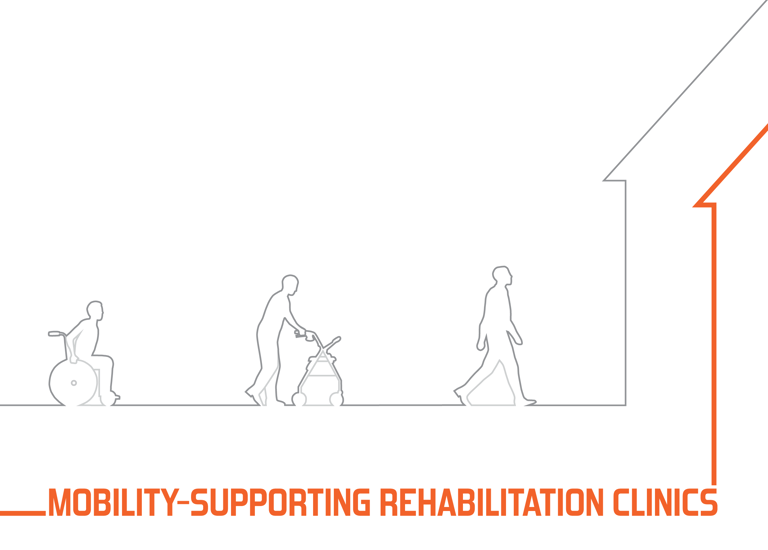
Mobility-Supporting Rehabilitation Clinics
Mobility-supporting Rehabilitation Clinics was a PhD research project by Maja Kevdzija that examines how the architectural design of inpatient rehabilitation clinics can support or hinder independent mobility after stroke. Based on post-occupancy evaluation in seven German neurological rehabilitation clinics, combining floor plan analysis, patient shadowing, and patient and staff questionnaires, the study distinguishes between scheduled (e.g., therapies, meals, appointments) and non-scheduled (voluntary) mobility, and identifies recurring architectural barriers and missing facilitators. The work culminated in an evidence-based catalogue of design guidelines and a “transitional model” to support more mobility-enabling rehabilitation environments. The project was funded by a PhD scholarship from the European Social Fund (ESF) and the Sächsische Aufbaubank.
Building Support for Children and Families affected by Childhood Stroke
BUILD CARE was a transnational project (2022–2025), funded through the European Joint Programme on Rare Diseases (EJP RD), bringing together architecture, cognitive neuroscience and health economics to examine how home, school and healthcare environments shape everyday life after childhood stroke across Austria, Belgium and Germany, and to develop design-relevant, publicly accessible outputs. BUILD CARE was coordinated by Dr.-Ing. Maja Kevdzija at TU Wien, in partnership with Technische Universität Dresden, KU Leuven, and the Medical University of Vienna.

The generation-friendly city (GESTA)
A participatory citizen-science project in Wiener Neustadt, funded through the Sparkling Science 2.0 call, brings school pupils, university students, and older adults together to explore how public spaces enable or hinder everyday participation across generations and to develop evidence-informed ideas for more age- and youth-friendly urban and public building design. "Die generationenfreundliche Stadt (GESTA)” is coordinated by FH Wiener Neustadt and carried out with academic partners University of Vienna, TU Wien, and the University of Applied Sciences and Arts of Western Switzerland, together with the school partner Caritas Schule Wiener Neustadt and societal partners City of Wiener Neustadt, Bibliothek im Zentrum, and Alzheimer Austria
