
New publication in Qualitative Health Research
A publication authored by Dr.-Ing. Maja Kevdzija entitled "Shadowing Stroke Patients to Explore the Rehabilitation Built Environment: Approach, Insights, and Lessons Learned," was published.
1/22/20251 min read
New publication in Qualitative Health Research
A publication authored by Dr.-Ing. Maja Kevdzija entitled "Shadowing Stroke Patients to Explore the Rehabilitation Built Environment: Approach, Insights, and Lessons Learned," was published.
In this article, Maja Kevdzija reflects on adapting patient shadowing as an architectural research method to understand how stroke inpatients interact with the rehabilitation built environment during recovery. The article is primarily methodological (the substantive empirical findings are reported elsewhere) and explains how shadowing can capture real-time, situated experiences of space that are hard to access through interviews or short observations alone.
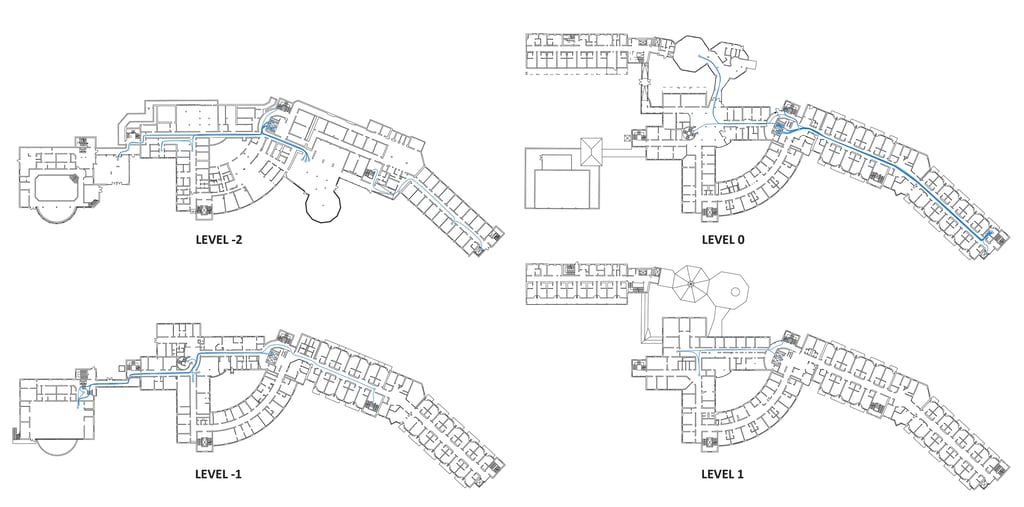
Empirically, the work involved 12 consecutive hours spent with each of 70 stroke inpatients during an “ordinary” rehabilitation day. Interactions with the built environment were documented through mapped routes and activity locations on floor plans, time logs, textual fieldnotes, patients’ remarks, and quick on-the-go prompts, sometimes complemented by simple sketches. For privacy reasons, observation focused on corridors and communal areas rather than on entering therapy or patient rooms.
A key contribution is the paper’s practical account of how spatial data were handled: floor plan mapping was used not just for documentation but also for analysis, including digitising and aggregating routes to identify patterns of activity locations, time use, distances travelled, and “critical” building areas where multiple patients encountered barriers or relied on environmental supports (e.g., corridor width, waiting/parking space, handrails, benches). The paper also discusses the realities of fieldwork in sensitive settings, especially unpredictability and ethical dilemmas (e.g., when a patient asks for physical help or becomes distressed), arguing for flexibility and prioritising a “do no harm” stance over data completeness.
The full open-access article can be found here.
