
New publication in Building and Environment
An article "A Computational Model for Linking Healthcare Architectural Variables with Health Outcomes Using Systems Engineering" was published in Building and Environment Journal.
1/1/20261 min read
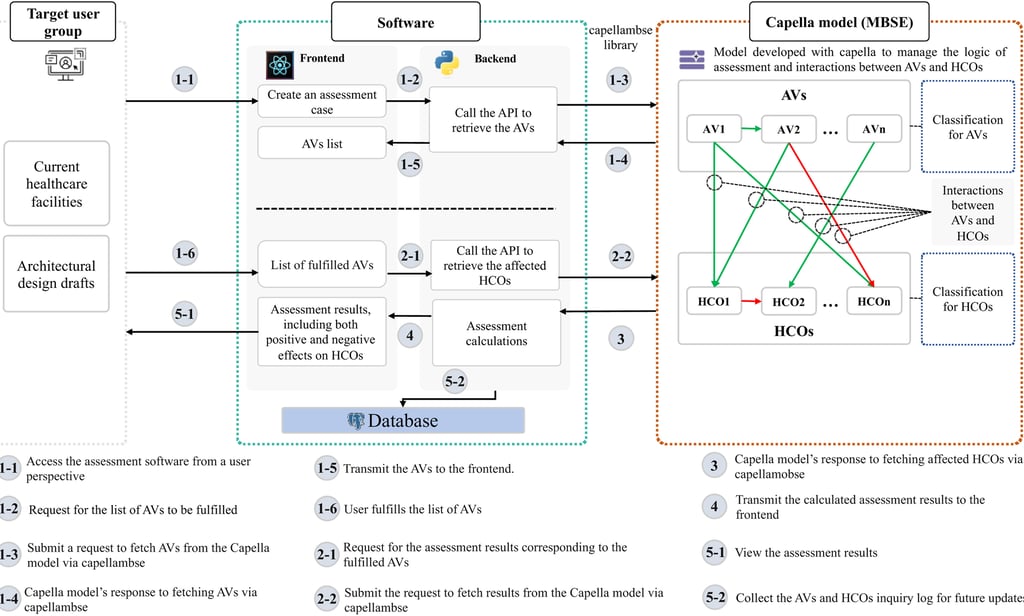
This article presents an open-access computational decision-support approach for healthcare design that aims to replace largely manual, checklist-style assessment tools with a software-driven model that links architectural variables to health and care outcomes. It’s positioned as a way to make evidence-based design relationships more traceable, comprehensive, and usable during iterative design and evaluation.
The calculation engine using Model-Based Systems Engineering (MBSE) was built. As a case study, we focus on dementia-friendly nursing home design and derive the model from a review of 105 evidence-based design studies, extracting 40 architectural variables (AVs), 36 health/care outcomes (HCOs), and 396 AV–HCO interactions. Importantly, the model includes not only direct AV→HCO links, but also indirect chains (AV–AV–HCO and AV–HCO–HCO), reflecting that design effects often operate through intermediate variables/outcomes.
A key practical contribution is a web-based interface where users enter a facility’s specifications (via structured fields/questionnaire) and receive near-instant feedback (reported as ~1–2 s processing time). Results are shown as positive vs negative effects and organised via an outcome classification (e.g., body-/mind-/human-being related categories), with drill-down to see which AV specifications contribute to particular outcomes. The system also preserves traceability to the underlying evidence (including DOIs) and flags conflicting evidence rather than averaging it away.
The tool is demonstrated through two real-case analyses and a comparative view against a literature-derived “benchmark,” intended to highlight improvement potential and surface indirect pathways that may generate design hypotheses for future research. Limitations tied to the underlying evidence base (coverage gaps and mostly directional findings) are noted, as are the interactions, which are treated equally at this stage (no weighting).
The paper is authored by Tahere Golgolnia, Timoleon Kipouros, P. John Clarkson, Maja Kevdzija, and Gesine Marquardt, and it is a collaboration between Technische Universität Dresden (Germany), the University of Cambridge (United Kingdom), and TU Wien (Austria). The full published article can be accessed here.
New publication in Building and Environment
The study reported in this article forms part of Tahere Golgolnia’s PhD thesis research (first author).
